
AI Meeting Tools Must Deliver Decisions, Not Summaries
Introduction
The first wave of AI meeting tools won attention by automating note-taking. That mattered. Teams were tired of losing decisions in messy notes, forgotten recordings, and scattered follow-up emails. But the market is already moving past that baseline.
Today, a transcript and a polite summary are not enough. Buyers want proof that a meeting assistant helps teams execute better after the call. If the output does not clarify decisions, assign ownership, surface next steps, and make prior discussions easy to retrieve later, the tool becomes another layer of information instead of a source of momentum.
That shift creates a real positioning opportunity for platforms like Upmeet.ai.
Summaries Have Become a Commodity
Most AI meeting products now promise the same first-order benefits: record the meeting, generate a transcript, and produce a summary. Those features are useful, but they are no longer differentiated. As more vendors deliver them, buyers stop asking whether a tool can summarize and start asking whether it changes what happens next.
That is a harder question, and it is the right one. In real businesses, meetings are not held to create summaries. They exist to make decisions, align teams, reduce ambiguity, and move work forward. A summary is only valuable if it improves those outcomes.
What Buyers Actually Need After the Meeting
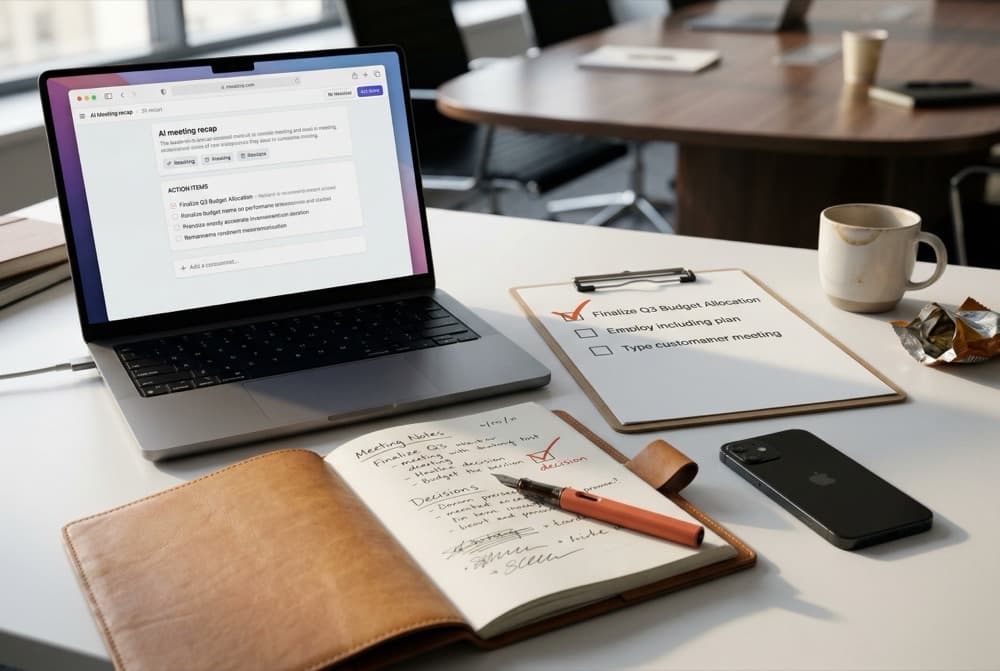
The real pain starts when the meeting ends. Teams forget who committed to what. Customer context gets trapped in one person’s memory. Action items disappear into chat threads. Decisions have to be revisited because nobody can find the original discussion.
This is where AI meeting tools need to evolve from passive documentation to operational usefulness.
A stronger product promise looks like this:
- decisions are captured clearly
- action items are easy to review and assign
- follow-ups are visible, not buried
- past meeting knowledge is searchable on demand
- teams can recover context without replaying entire calls
That is much closer to business value than “we generate clean summaries.” It speaks to accountability, speed, and organizational memory.
The Better Category Story
For Upmeet.ai, the strategic move is to position the product around execution after meetings, not transcription during meetings.
That means marketing should lead with the practical outcome: helping teams capture discussions, surface decisions, organize action items, and retrieve what matters later through conversational search. This framing is stronger because it matches how buyers justify software spend. They are not buying an AI novelty. They are buying less confusion, faster follow-through, and fewer dropped balls.
It also creates cleaner differentiation. Many competitors still sound like generic “AI note takers.” A brand that speaks directly to post-meeting clarity and accountability is selling a sharper business result.
How to Make the Message Land
If you want this positioning to convert, avoid vague AI language. Be explicit about the customer problem and the workflow improvement.
Instead of saying the product “transforms collaboration,” say it helps teams remember decisions, track follow-ups, and query past meetings without manual note-taking.
Instead of centering the transcript, center the operational outcome:
- better alignment after leadership meetings
- clearer ownership after customer calls
- faster handoffs across sales, success, and operations
- a searchable memory for the organization
This message is especially effective for SMB and mid-market teams, where meetings drive execution but process is often inconsistent. Those buyers feel the cost of forgotten context immediately.
Conclusion
The AI meeting category is growing up fast. Summary generation opened the door, but it will not be enough to win trust or budget in the next phase of the market.
The tools that stand out will be the ones that turn meetings into clear decisions, visible action, and usable company memory. That is the outcome buyers actually care about.
CTA
If you want to position Upmeet.ai for the next phase of the category, stop selling summaries as the headline. Sell what teams get after the meeting: clarity, accountability, and faster execution.