Claude Cowork Needs Upmeet for Meeting Follow-Through
Introduction
General-purpose AI assistants are becoming real coworkers. Teams now use tools like Claude to brainstorm ideas, draft documents, summarize thinking, and accelerate day-to-day execution. That shift is valuable, but it also creates a strategic misunderstanding: an AI coworker is not automatically a meeting system of record.
When companies rely on meetings to move projects, close deals, align teams, and make decisions, they need more than a smart assistant in the workflow. They need a dependable layer that captures what happened in the meeting, identifies what matters next, and makes follow-through easy to retrieve. That is where Upmeet fits.
Claude helps people work faster
Claude is strong when the job is thinking, writing, synthesizing, or exploring options. It can help a manager prepare an agenda, rewrite a follow-up email, draft a strategy note, or structure ideas after a conversation. In that sense, it behaves like a productive AI coworker: always available, fast, and useful across many tasks.
That flexibility is exactly why teams like it. But flexibility also has limits. A general AI assistant is not designed to become the trusted operational memory for every live meeting across the organization.
Meetings need a source of truth
The real business cost of meetings usually shows up after the call. Decisions get forgotten. Owners are unclear. Customer context disappears into personal notes. Promises made in a sales or success conversation are hard to recover later. Teams remember the discussion differently, and execution slows down.
This is the gap specialized meeting AI must solve. Upmeet complements Claude by handling the part of work that depends on meeting accuracy and retrieval. It records meetings, produces transcripts, generates structured summaries, surfaces action items, and lets teams query past meetings conversationally.
That matters because post-meeting execution depends on reliable context, not just a helpful chat interface.
Why the combination makes sense
The better way to think about this category is not Claude versus Upmeet. It is Claude plus Upmeet.
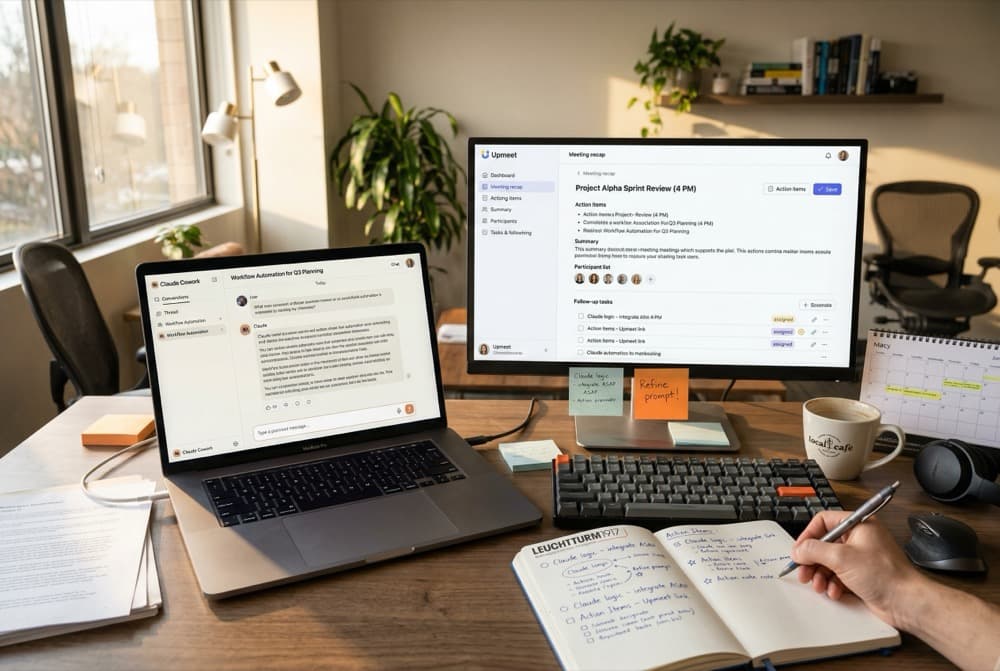
Claude can help a user think through what to do next. Upmeet can help the organization remember what was actually said, decided, and assigned. Claude supports individual productivity. Upmeet strengthens shared accountability.
For example:
- A sales manager can use Claude to shape a follow-up plan, while Upmeet preserves the exact customer concerns and next steps from the call.
- An operations lead can use Claude to draft an internal memo, while Upmeet captures the decisions and owners from the planning meeting that memo depends on.
- A customer success team can use Claude to refine messaging, while Upmeet keeps a searchable history of commitments, blockers, and action items across meetings.
In each case, Claude helps generate output. Upmeet protects the meeting truth behind the output.
What buyers should evaluate
As AI coworkers become mainstream, buyers should ask a more disciplined question: where do we want general AI assistance, and where do we need specialized workflow reliability?
If the goal is faster drafting, analysis, and ideation, Claude is a strong fit. If the goal is capturing meeting memory, structuring follow-through, and making organizational context retrievable, a dedicated meeting layer becomes essential.
That is the practical role Upmeet can play. It does not replace general AI coworkers. It complements them by giving teams a dependable system for meeting intelligence and post-meeting accountability.
Conclusion
The market is moving toward AI-assisted work everywhere, but not every AI tool should do the same job. General assistants like Claude are powerful coworkers. Specialized tools like Upmeet become valuable when teams need meeting accuracy, continuity, and execution after the conversation ends.
CTA
If your team is adopting AI coworkers, make sure you are also building a reliable meeting memory layer. Upmeet helps capture discussions, decisions, and action items so your team can turn meetings into accountable follow-through.