
How Product Owners Use AI to Pressure-Test Strategy
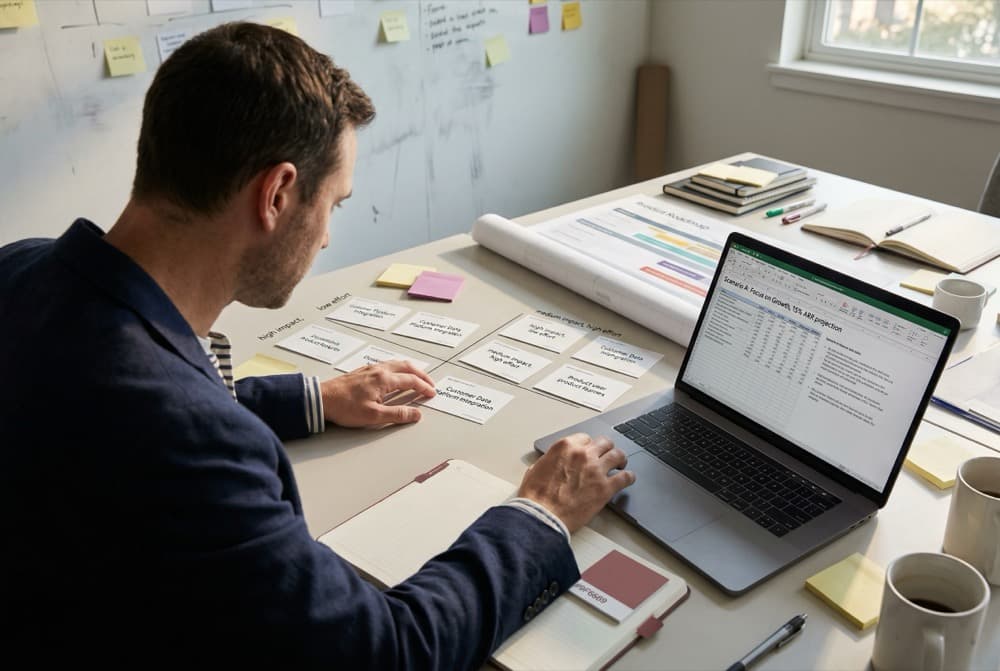
Product owners are often told to move faster, align stakeholders, and make better roadmap choices with incomplete information. The problem is not a lack of ideas. It is the volume of competing signals: customer feedback, sales requests, product analytics, support pain points, technical debt, and leadership expectations. AI can help, but not in the simplistic “let the model decide” way. The real value is using AI as a structured thinking partner that helps product owners test assumptions before they commit time, budget, and engineering capacity.
Move AI upstream in the decision process
Many teams use AI too late. They ask it to summarize research, rewrite specs, or clean up backlog items after the strategic choice is already made. A stronger use case is to bring AI in earlier, when the product owner is still evaluating options.
At that stage, AI can help organize inputs, highlight trade-offs, and expose weak logic. For example, a product owner can feed the model a short brief with target users, business goals, known constraints, and three possible initiatives. The prompt should not ask, “What should we build?” It should ask, “What assumptions are hidden in each option? What risks are underpriced? What evidence is missing before we prioritize this?”
That changes AI from a content generator into a strategy pressure-test tool.
Use AI to challenge assumptions, not replace judgment
Good product strategy is not only about picking what sounds valuable. It is about seeing the second-order effects. If a team prioritizes a feature for a vocal customer segment, what gets delayed? If a roadmap item improves activation, does it hurt usability for existing power users? If a request looks urgent, is it truly strategic or just visible?
AI is useful here because it can quickly simulate multiple lenses:
- customer value
- revenue impact
- delivery complexity
- retention implications
- operational risk
- dependency risk
A product owner can ask AI to score or compare options, but the real advantage comes from the reasoning around the score. The best prompts force AI to explain trade-offs, identify missing evidence, and surface the assumptions that deserve human debate.
Turn qualitative noise into structured comparison
One of the hardest parts of the product owner role is converting messy feedback into a clear prioritization view. AI can help cluster themes across interviews, support tickets, win-loss notes, and internal requests. That gives the product owner a more structured picture of repeated pain points instead of reacting to the loudest stakeholder.
Used well, AI can also help map signals against a decision framework such as impact versus effort, strategic fit, urgency, or expected learning value. This does not eliminate product thinking. It makes the thinking more explicit and easier to defend in roadmap conversations.
Create scenario-based planning faster
Strategic product choices often fail because teams evaluate only the preferred path. AI can accelerate scenario planning by helping product owners explore alternatives quickly.
A useful workflow is simple: ask AI to produce three scenarios for a proposed initiative — best case, realistic case, and downside case. Then ask what would need to be true for each scenario to happen. From there, the product owner can identify what evidence to validate before moving forward.
This is especially valuable when the team must choose between growth bets, usability improvements, and platform investments. AI helps frame the discussion, but the product owner still decides which trade-off matches company strategy.
Build a repeatable decision habit
The biggest win is not a single better prompt. It is a repeatable operating model. Product owners should use AI with a consistent set of questions:
- What assumption am I making?
- What evidence is still weak?
- What customer segment benefits most?
- What opportunity cost am I ignoring?
- What would make this priority a bad choice in six months?
When AI is used this way, it becomes a decision-quality amplifier.
Conclusion
AI will not replace strategic product judgment. But it can help product owners make sharper choices, faster, with better visibility into trade-offs, blind spots, and evidence gaps. The teams that benefit most will not be the ones using AI to produce more documents. They will be the ones using it to think more rigorously before the roadmap is locked.
CTA
If you are a product owner, start with one upcoming roadmap decision and use AI to pressure-test the assumptions behind it. You may not change the final choice, but you will almost certainly improve the quality of the reasoning behind it.