
The "Agentic Action" Audit: Why 2026 Meetings are Abandoning Transcripts for Autonomous Workflows
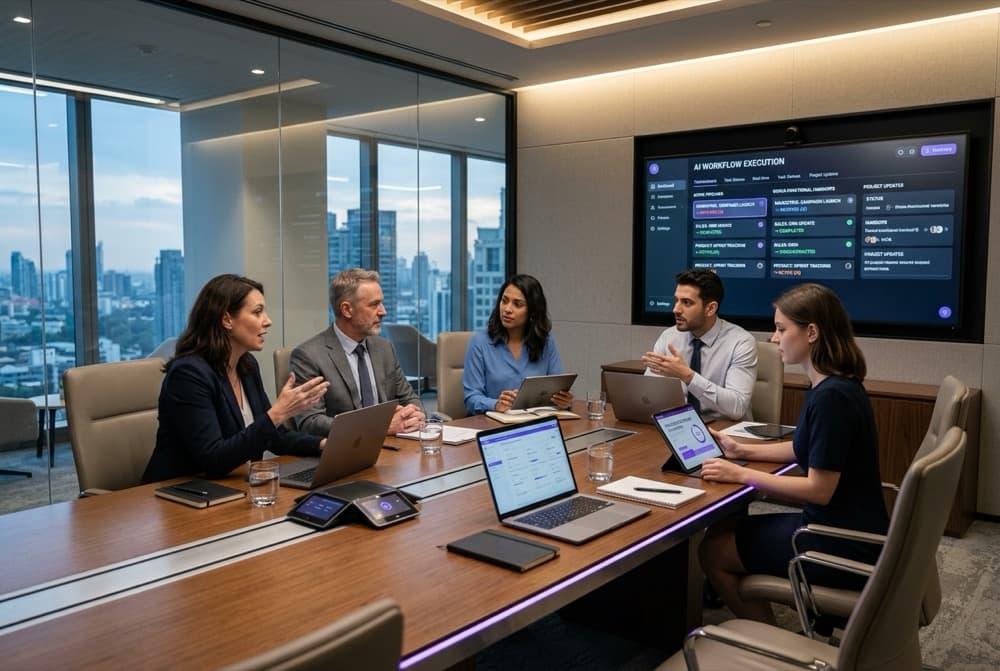
For years, the "AI meeting assistant" was defined by its ability to listen. In 2024 and 2025, enterprise success was measured by the accuracy of a transcript or the conciseness of a summary. But as we move through 2026, the novelty of "knowing what was said" has worn off, replaced by a more pressing demand: knowing it actually got done.
We have entered the era of the "Agentic Action" Audit. Organizations are no longer satisfied with passive knowledge capture; they are shifting toward autonomous workflows that close the gap between discussion and execution. For RevOps leaders and Chiefs of Staff, the 2026 mandate is clear: move beyond the transcript or risk drowning in documented, but unexecuted, data.
The Rise of Transcript Fatigue
The promise of the early AI era was that better documentation would lead to better results. Instead, many mid-to-large tech organizations hit a wall of "transcript fatigue." Leaders found themselves with 40-page searchable histories of every meeting, yet the "execution gap"—the delay between a decision being made and its implementation in Jira, Salesforce, or Linear—remained unchanged.
Passive recorders captured the what, but they lacked the how. This friction has turned meeting accountability into a top-tier operating KPI. In a high-efficiency market, a meeting that doesn't trigger a downstream system update is now viewed as an operational failure.
From Recorders to Doers: The Agentic Shift
The defining trend of 2026 AI business trends is the transition from "AI as Observer" to "AI as Operator." Agentic AI doesn't just sit in the call; it understands the context of the technical infrastructure surrounding the team.
Rather than providing a bulleted list of "Next Steps" for a human to copy-paste, autonomous meeting workflows now handle the heavy lifting:
- Autonomous Resource Allocation: If a Product Manager agrees to a feature pivot during a sprint review, agentic tools don't just note it—they draft the updated requirements and cross-reference resource availability in real time.
- Automated Accountability: Strategic follow-through is no longer dependent on manual reminders. When a RevOps leader sets a target in a weekly sync, the AI establishes the tracking logic in the CRM immediately following the call.
- Cross-System Synthesis: Modern agentic workflows bridge the silo between the meeting (where decisions happen) and the project management suite (where work happens).
Closing the Execution Gap with Upmeet AI
To thrive in this environment, teams are adopting tools designed for follow-through. Upmeet AI features exemplify this shift by focusing on knowledge capture automation that is inherently bi-directional. It doesn’t just pull information out of the room; it pushes action into your tech stack.
By leveraging AI project management integration, these workflows ensure that "agentic action" is auditable. You can see exactly when a discussion point became a ticket, who was assigned, and how it aligns with the broader roadmap. This level of automated accountability transforms the meeting from a time-sink into a high-velocity engine for the business.
The New Standard: The Action-First Workflow
As we look toward the second half of 2026, the "Agentic Action" Audit will become the standard for high-performing teams. If your current AI assistant only gives you words, it’s already obsolete. The goal is a workflow where the meeting is the trigger, and the execution is the default.
RevOps and product leaders must audit their current meeting culture. Are you recording for the sake of history, or are you automating for the sake of progress? The organizations that lead in 2026 will be those that treat their AI not as a secretary, but as a system administrator.
Conclusion
The transition from passive transcription to autonomous execution is the logical conclusion of AI maturity. Meeting accountability is no longer a "soft skill"—it is a hard metric powered by agentic systems. By closing the execution gap, teams can finally stop talking about the work and start trusting that the work is already in motion.
Is your team still stuck in the era of transcripts? Audit your meeting workflows today. Experience how Upmeet AI turns discussions into documented, automated outcomes.