
The "Post-Summary" Pivot: Ending "Decision Drift" with Conversational Intent Retrieval
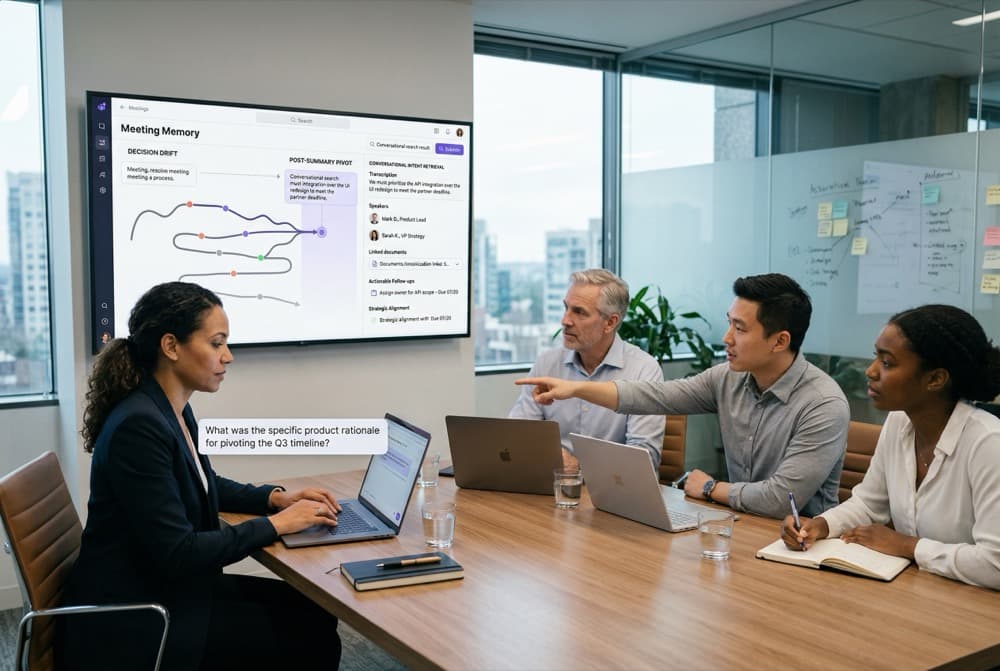
In the high-stakes environment of 2026, the traditional meeting summary has hit its ceiling. While generic AI-generated bullet points have become a commodity, they often lack the technical depth required to prevent execution errors in complex, long-cycle builds. For PMO Directors and Solution Architects, the challenge has shifted from "What was said?" to "Why was this decided?"
When the rationale behind a technical pivot or a stakeholder’s specific nuance is lost, teams fall victim to Decision Drift. This phenomenon—where project execution slowly diverges from original intent—is a leading cause of mid-project pivots and misaligned client expectations. To combat this, high-performing teams are moving beyond passive archiving toward Conversational Intent Retrieval.
The Summary Ceiling and the Need for High-Fidelity Context
By now, most enterprises have a repository full of transcripts and "action items." However, these static summaries rarely capture the "logic gaps" or the specific tone of a stakeholder’s constraint. In R&D-heavy firms and mid-market consultancies, failing to capture the why leads to expensive rework.
We are currently facing a Knowledge Liquidity Crisis. With record-high workforce mobility in the 2025–2026 cycle, documentation has become fragile. When a key expert departs, their tribal knowledge often goes with them. Static summaries cannot fill this void; only a queryable "Company Mind" can ensure that the original intent remains accessible to those left behind.
Upmeet: From Data Graveyard to Meeting Reasoning Engine
Upmeet transforms your meeting history from a passive archive into an active tool for enterprise context management. While it performs the essential tasks—recording meetings, creating accurate transcripts, and generating structured summaries with follow-up items—its true power lies in its ability to facilitate conversational intent retrieval.
Rather than scrolling through months of transcripts to find a single technical justification, project leads can interview their own meeting history. Upmeet allows users to query past sessions conversationally, surfacing the specific reasoning behind a decision made weeks or months prior.
Key Capabilities for Precision Mandate:
- Conversational Querying: Ask your repository specific questions like, "Why did the lead architect reject the initial database schema in the February kickoff?"
- Tribal Knowledge Extraction: Recover the logic used by departed team members to maintain continuity in long-term initiatives.
- Verification of Intent: Project leads can verify original stakeholder requirements in seconds, ensuring "First-Time-Right" delivery and reducing the cost of mid-project corrections.
Eliminating Decision Drift in 2026
In a "First-Time-Right" delivery climate, the margin for error is non-existent. Decision Drift happens when teams rely on secondary interpretations (summaries) rather than primary intent. By utilizing Upmeet as a meeting reasoning engine, firms can anchor their execution in high-fidelity context.
This transition from "Summary" to "Intent Retrieval" represents a strategic pivot for operations leads. It’s no longer about having a record of the meeting; it’s about having a queryable asset that protects the project’s integrity against time, turnover, and technical complexity.
Conclusion
The era of passive AI summaries is over. To lead in 2026, PMOs and Solution Architects must prioritize the depth of their institutional memory. Upmeet provides the infrastructure to stop Decision Drift by turning every meeting into a permanent, searchable, and conversational part of your company’s collective intelligence.
Stop guessing at intent. Start retrieving it.
Ready to transform your meeting repository into a queryable "Company Mind"? Explore how Upmeet can secure your tribal knowledge and streamline your project delivery today.